AI is currently everywhere in music production.
And let’s be honest. A lot of it feels either completely unnecessary or just plain bad.
“AI-powered mastering.”
“One-click professional mixes.”
“Replace your engineer.”
Most of it sounds more like startup pitch decks than actual music production tools.
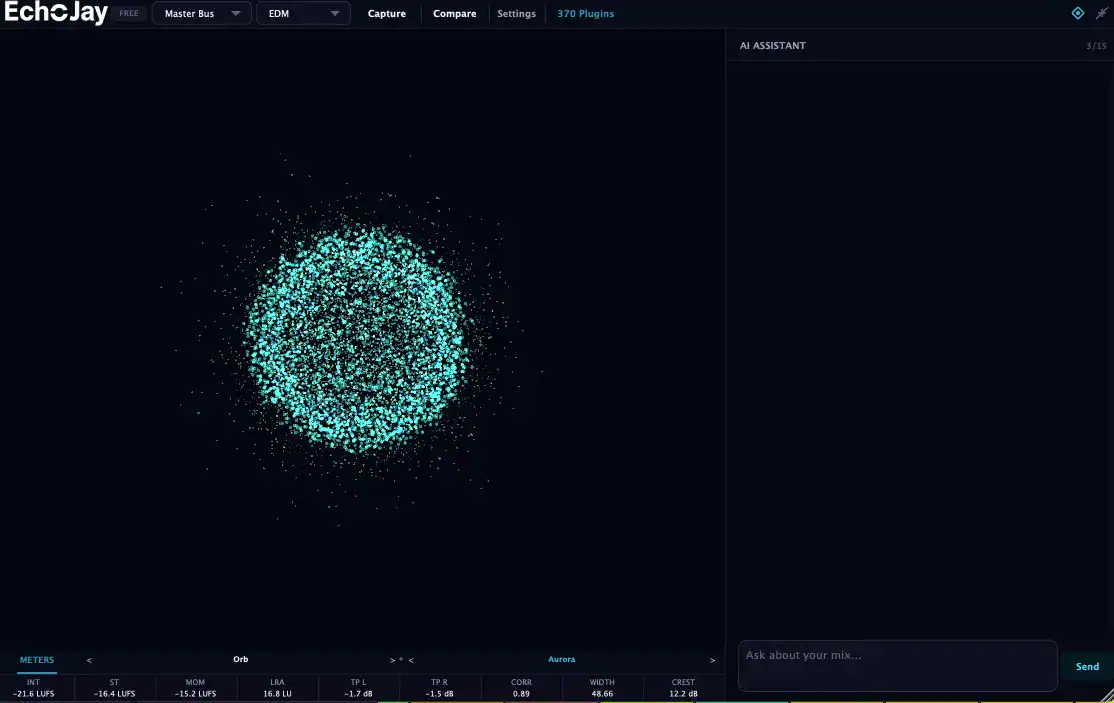
Then something like EchoJay shows up and takes a slightly different approach.
And honestly?
That’s probably why it caught my attention.
Instead of pretending to replace producers, engineers or creative decisions, EchoJay positions itself more like a technical assistant. A second opinion. A workflow helper.
That already makes far more sense than half the AI tools currently flooding the market.
What Is EchoJay?
EchoJay is an AI-powered mixing assistant available as both a browser app and a DAW plugin supporting VST3, AU and AAX formats.
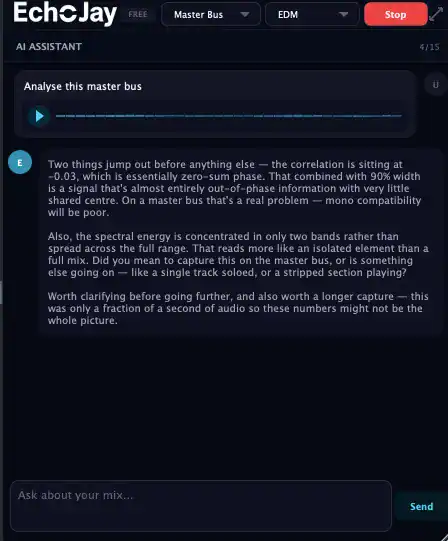
The platform analyses your audio and provides feedback based on actual measurable data such as:
- LUFS
- True peak
- Stereo width
- Dynamics
- Crest factor
- Spectral balance
- Reference comparisons
That’s important.
Because there is a huge difference between:
“Your mix sounds warm and emotional.”
…and:
“Your low mids are overloaded and your dynamics are collapsing.”
One is vague marketing fluff.
The other is potentially useful information.
EchoJay seems to focus more on the second approach.
AI That Doesn’t Pretend To Be The Artist
This is probably the strongest thing about EchoJay.
It doesn’t appear to market itself as:
- fully automated mixing
- AI-generated creativity
- or “push button and release your album.”
Instead, you remain in control the whole way through.
And that matters.

Because mixing is still about:
- taste
- decisions
- emotion
- context
- experience
No AI knows what you are actually trying to achieve creatively.
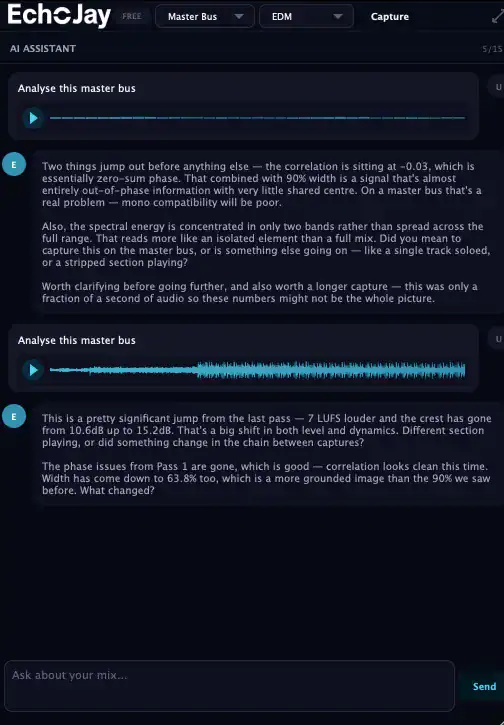
A dark industrial ambient track should not be mixed like polished EDM.
A lo-fi techno track should not necessarily sound “correct.”
Some genres are literally built around imperfections.
EchoJay seems aware of this.
It analyses data and gives suggestions.
You decide what to do with them.
That is a far healthier approach to AI in music production.
Does It Actually Work?
That’s the real question.
And honestly?
You’d be the judge of that.
Not YouTubers.
Not influencers.
Not people farming affiliate links.
Your ears decide.
From what I can see, EchoJay probably works best as:
- a technical assistant
- a fast second opinion
- a learning tool
- or a workflow accelerator
And to be fair, measurable things can absolutely be analysed properly by software.
We already rely on:
- spectrum analysers
- loudness meters
- reference plugins
- room correction systems
- dynamic analysers
EchoJay simply combines some of those ideas into a more conversational AI workflow.
That part actually makes sense.
The Interesting Part: Perspective
One of the biggest problems during mixing is losing perspective.
After listening to the same loop for:
- 2 hours
- 5 hours
- or 3 days straight
…your ears stop being objective.
Everything starts sounding normal.
Even the terrible decisions.
That’s where a tool like EchoJay could become genuinely useful.
Not because it magically fixes the mix.
But because it points at areas you may no longer notice yourself.
Examples could be:
- muddy low mids
- excessive stereo width
- harsh resonances
- over-compression
- poor loudness balance
That kind of feedback can absolutely speed things up.
The Danger With AI Mixing
Of course there is also a downside.
The danger with AI assistants is dependency.
Especially for beginners.
There is a risk people start trusting graphs and suggestions more than their own ears.
And that becomes a problem very quickly.
Because music is not mathematics.
Some of the greatest electronic music ever made technically breaks all the “rules”:
- distorted kicks
- clipped masters
- overloaded tape saturation
- noisy recordings
- ugly compression
Those imperfections often become the identity of the music.
So tools like EchoJay should probably be treated as:
- guidance
- technical assistance
- workflow support
—not creative authority.
Reference Mixing Looks Useful
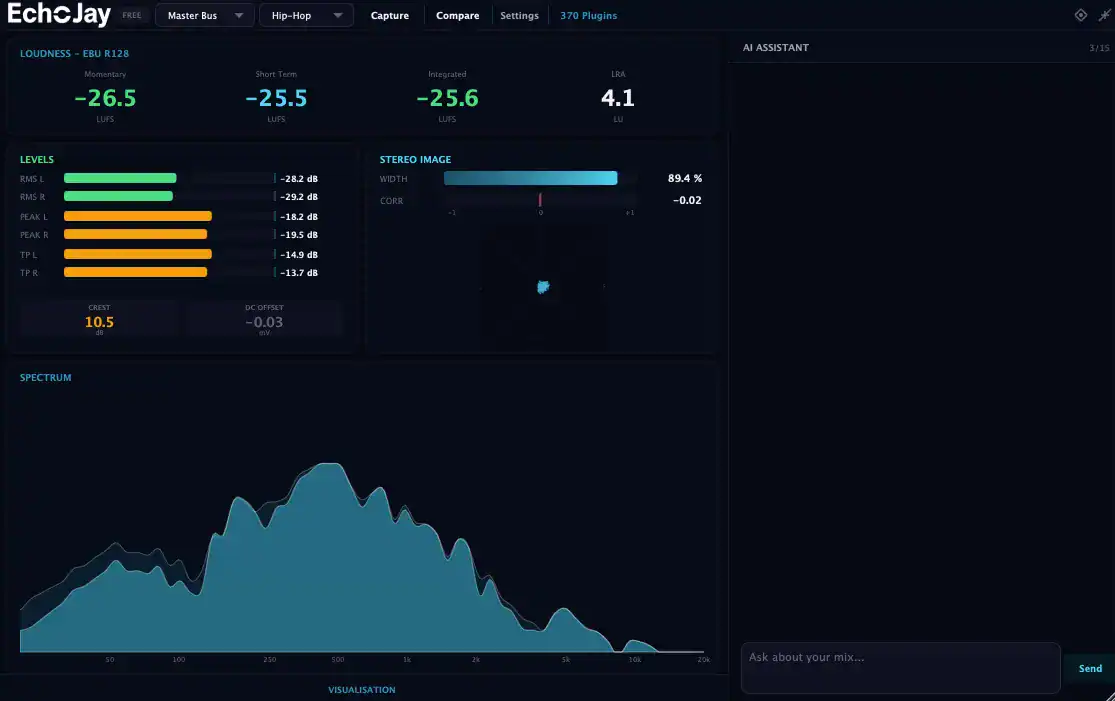
EchoJay also includes reference comparison tools where you can compare your mix against commercial releases.
Things like:
- loudness
- EQ balance
- stereo image
- dynamics
Again, this is not entirely new territory.
Plugins like:
- Metric AB
- Reference 2
- Tonal Balance Control
- smart:EQ
…already cover parts of this workflow.
But combining it into a single AI-assisted environment could actually be practical.
Less plugin hopping.
Less staring at graphs.
More focus on actual mixing decisions.
Could Professionals Use It?
Probably yes.
Not because professionals suddenly forgot how to mix.
But because experienced producers also use:
- references
- analysers
- metering
- loudness tools
- room correction
- visual feedback
EchoJay simply modernises some of that workflow.
The difference is:
it doesn’t seem obsessed with replacing the human.
That alone already puts it ahead of many AI products currently being pushed into music production.
Pricing
EchoJay currently offers:
- Free tier
- Pro subscription
- Studio subscription
The free version includes the metering suite along with limited AI messages each month.
Which is honestly a smart move.
People can actually test whether the workflow helps them instead of immediately throwing money at another “revolutionary AI platform.”
First Impression
My first impression?
EchoJay feels like one of the more sensible AI tools currently appearing in music production.
Not because it replaces skill.
But because it supports it.
That is a major difference.
It feels less like:
“AI will replace engineers.”
…and more like:
“Here’s useful technical feedback. Now go make your own decisions.”
And in today’s AI circus, that already feels surprisingly refreshing.
Similar Tools Worth Checking Out
If this type of workflow interests you, you may also want to look into:
- Sonible smart:EQ 4
- iZotope Neutron
- Mastering The Mix Reference 2
- ADPTR MetricAB
- Process Audio Sugar
All of them approach analysis and mixing support differently, but EchoJay’s conversational AI angle definitely gives it its own identity.